


The Men’s Edition
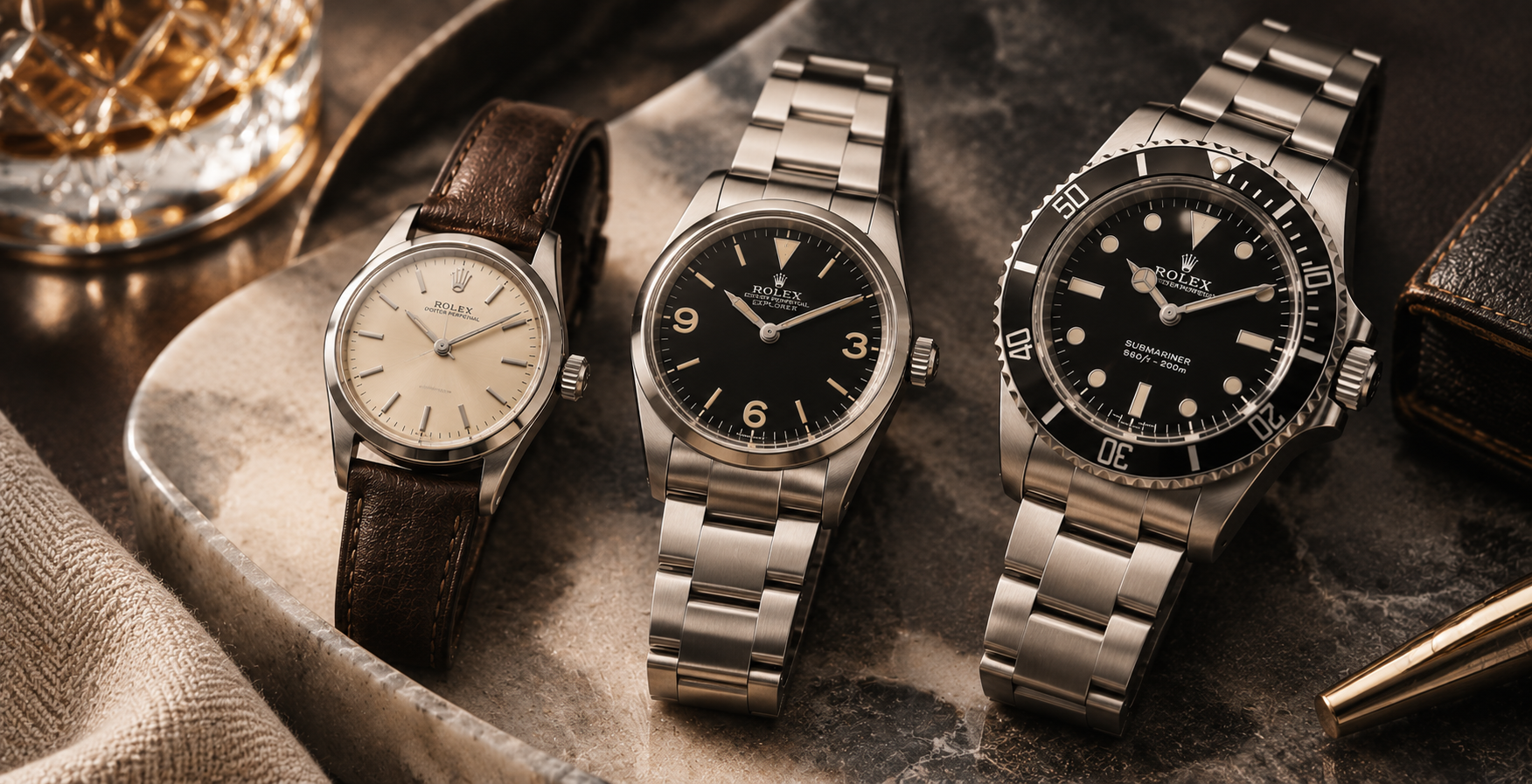
Watch size, case diameter in particular, is one more thing that is apparently inflation-prone. Traditional models had found a sweet spot around the 36 mm mark, and even early sports models did not go beyond 39 mm. The past few decades have seen the introduction of cases well beyond 42 mm. The trend now seems to be reversing, with many of the top marques returning to more modest sizes.
At Watchpoint we dispense styling advice undogmatically; we generally believe in deferring to personal taste. Sizing might be the one area where we become slightly more insistent. Granted, you are not as restricted as with shoe sizing, for example. If, however, you are not mindful of symmetry and proportions, the end result might be rather unsightly. That means you’ll be less likely to wear your newly acquired treasure.
Here are a few things to consider.
The case diameter refers to the external measurement between the 3 o’clock and 9 o’clock positions, crown excluded. You can determine your wrist circumference by wrapping a tailor’s measuring tape around the spot on your wrist where the watch will fit. A wrist circumference of 6-7 inches, or 15-18 cm, generally pairs well with a case diameter between 36 and 42mm. Larger wrists can accommodate larger case diameters.
The lug-to-lug measurement also plays a role: a short lug-to-lug will make a 42 mm watch, for example, wear smaller than the number suggests. A long lug-to-lug,
conversely, might make a smaller dress watch look rather sharp on a hefty wrist. If the lugs extend beyond your wrist bones, that watch is probably not for you.
Equally important is the case thickness. A beefy case will make a watch appear larger, and pair less easily with shirt and jacket cuffs. An arced case will generally make a watch more elegant and visually compact. The more complicated the movement — as with divers and chronographs, for example — the thicker the case tends to be. Of course, all the features that typically come with tool watches — graduated bezels, pushers, subdials — add visual weight.
A few more details are also merit consideration. A sloping bezel, as opposed to a flat one, will decrease size visually. As it is with clothing, dark tones have a slimming effect. A diver with a 42 mm case diameter will appear smaller if it has a murdered out case and other dark accents, such as a dark dial and bezel. The strap or bracelet can add or substract visual size. Metal bracelets generally look and feel heavier. The strap / bracelet should also be proportional to the case size; a 42 mm case, for example, pairs well with a 22 mm strap.
When deciding on a watch, you should also consider your entire frame, not just your wrist. It is almost impossible to make an oversized tool watch appear graceful on a skinny, short-statured person; a vintage, 32 mm dress watch will not look right on a musclebound bouncer.
Finally, a watch’s spec sheet, however detailed, will only take you so far; a test ride is essential. Find a dealer who will let you try it on for size. Seeing is believing.