


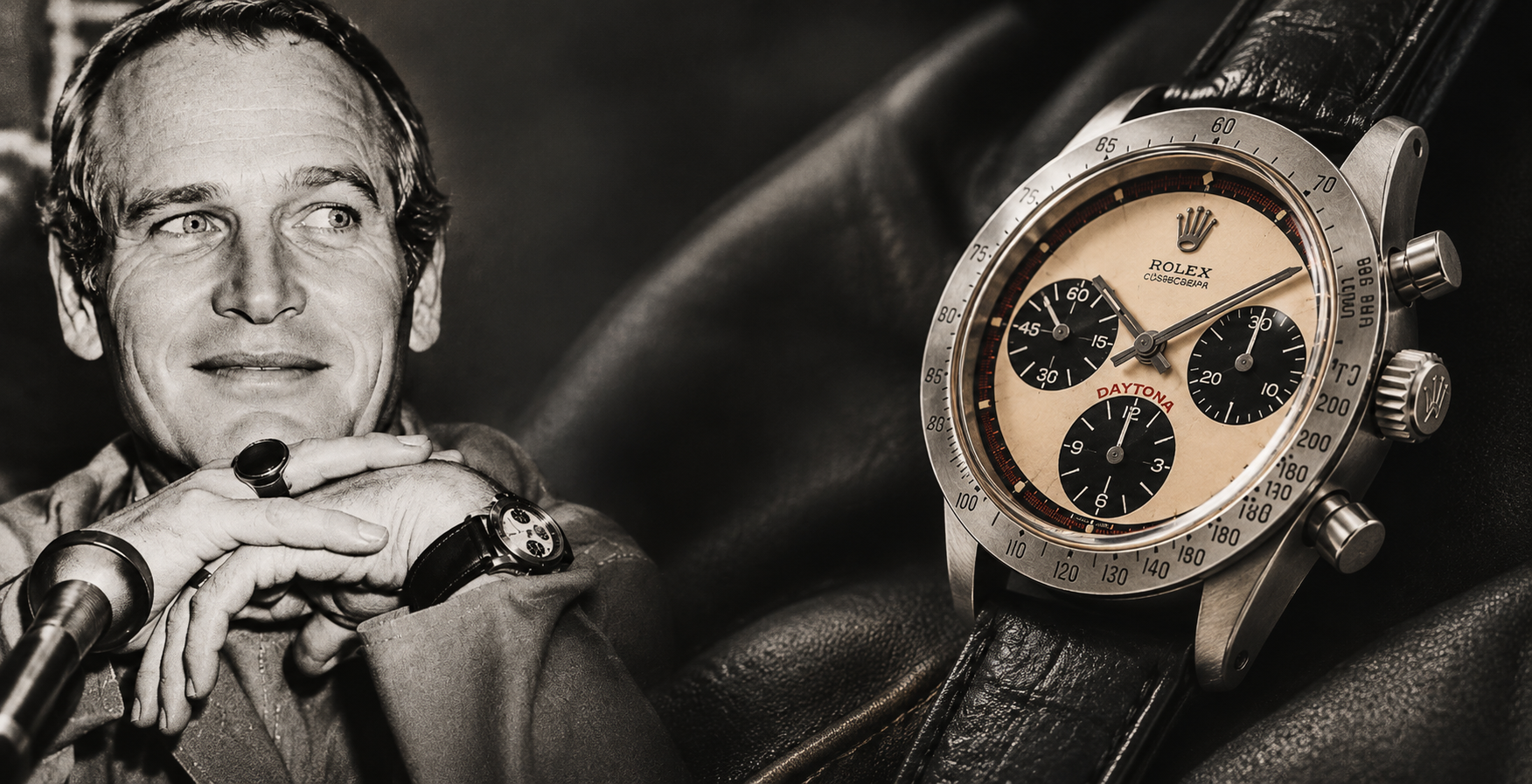
There is no model in Rolex’s current range that is named after a contemporary movie star, and not because the world’s biggest high-end watch brand is conservative and prone to nostalgia. In fact, when the company gave the ‘Paul Newman’ moniker to the Daytona, the elder-statesman aura had not yet settled around the man. Rather, our hyper-connected, informationally glutted era simply does not produce stars of Newman’s calibre.
He did not acquire his iconic status overnight. His celluloid beginnings were certainly inauspicious; his first lead was in a historical epic of ‘jaw-dropping mediocrity’, as a critic recently put it. And as he himself reveals in a posthumously published autobiography, he was plagued by chronic self-doubt.
So there were bumps along the way. But he ended up with a body of work that contains more than its fair share of gems. He starred in such era-defining films as Cool Hand Luke (1967) and Butch Cassidy and the Sundance Kid (1969), portrayals that brim with exuberance and mischief. Though both those films struck subversive, countercultural notes, Newman never became permanently associated with any current, and managed to make a smooth transition to mature roles. That is not a trivial accomplishment for a man of such striking looks, especially in an industry that refuses to come to terms with ageing, graceful or otherwise. His career’s top accolade came when he was in his sixties. His turn as Edward ‘Fast Eddie’ Felson in The Color of Money (1986), a long-in-the-tooth pool hustler who still has a trick or two up his sleeve, earned him an Academy Award.
His longevity and late-in-life bankability seem all the more impressive in light of the aforementioned revelation. When you add his extra-cinematic ventures — salad-dressing creator and manufacturer, auto-racing driver and team owner, philanthropist and civil-rights campaigner whose foundation’s total donations exceed half a billion dollars — the phrase ‘embarrassment of riches’ feels very much like an understatement.
The Watch
The Daytona line is actually made up of three series of models, of which the ‘Paul Newman’ is only the first. Produced between 1963 and the late 80s, the ‘Paul Newman’ series has four-digit reference numbers and manual winding. The models of the second Daytona series, produced between 1988 and 2000, have five-digit reference numbers and automatic winding. The third-series models, produced from 2000 onwards, feature six-digit reference numbers, automatic winding and an in-house movement.
Newman wore the ref. 6239. It shares a number of features with its series-mates: the domed acrylic crystal; the block markers and centre crosshairs in each of the three subdials; and arabic numerals at the 15, 30, 45 and 60 positions of the seconds subdial. The 6239 comes with a white or black dial, a tachymeter-equipped, stainless-steel bezel and pump pushers. Its movement is the 17-jewel, 18,000 beats-per-hour Valijoux 722. ‘Daytona’ is written in red above the 6 o’clock position.
Daytonas were reportedly not that popular in 1968, when Newman’s wife, the actress Joanne Woodward, gave him the 6239 with the white dial as a present. They are now the most expensive models in the Rolex range. When the late actor’s family members put up his 6239 for auction in 2017, it fetched nearly 18 million dollars. Hold the scoffing — in classic Newman fashion, the proceeds went to charity.