


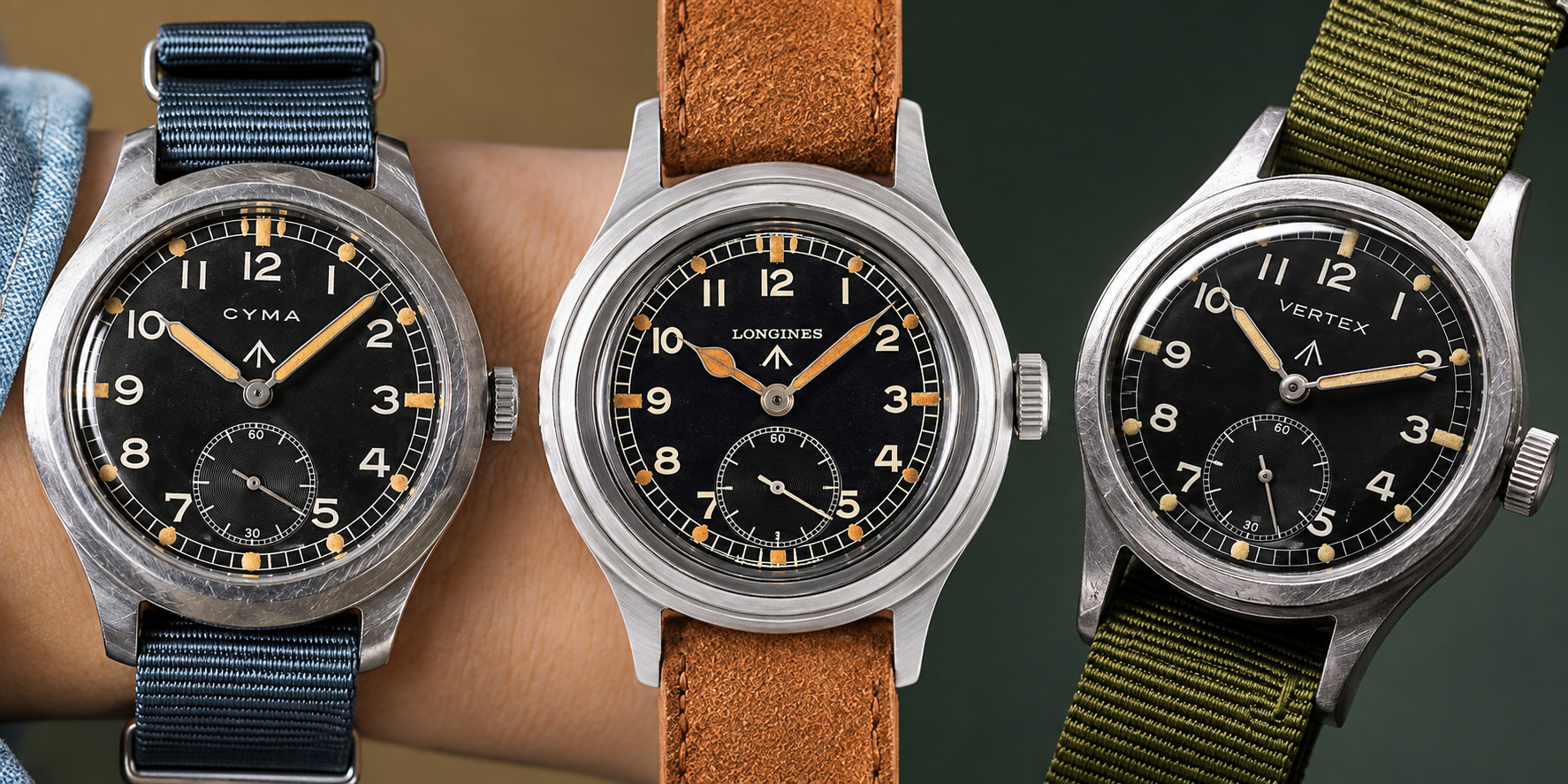
It is one of life’s inconvenient truths but few things propel technological innovation like war. A technology that is ‘good enough’ for civilian applications often won’t cut it in the high-stakes situations routinely faced by military personnel. The need to gain an edge on the battlefield does wonders for producing inventions and refining existing designs. Many of these products eventually filter through to the civilian world and add to the convenience and economic dynamism of modern life. Fields such as telecommunications, automotive engineering, computing and — naturally — horology owe much of their advance to our bellicose instincts.
An horological case in point: in 1945 Britain sought to equip its soldiers with a wristwatch that was more accurate and robust than those in its military stock or on the civilian market. With domestic watch manufacturers either lacking adequate production capacity or already serving different supply needs, the British Ministry of Defence decided to invite tenders from Switzerland. A total of twelve companies were approved — hence, the ‘Dirty Dozen’. They were Buren, Cyma, Eterna, Grana, Jaeger Le-Coultre, Lemania, Longines, IWC, Omega, Record, Timor and Vertex. A thirteenth company, Enicar, did receive the commission but apparently never delivered. Approximately 150,000 pieces were collectively produced. Omega’s and Record’s yields were the highest (25,000 each), Grana’s the lowest (1,500).
As they were intended for field duty, they had to be legible, accurate and durable. Accordingly, the MoD’s brief called for luminescence, chronometer-level regulation and water resistance. The brief also required a black dial, Arabic numerals, a railroad minute track, a shatterproof crystal, a stainless-steel case and a 15-jewel movement.
The resulting pieces bear a number of identifying marks. On the caseback the code W.W.W. is engraved, which stands for Watch.Wrist.Waterproof. There are also two serial numbers: the manufacturer’s number and a military store number. Both the dial and the caseback bear a broad arrowhead, which designates them as Crown property.
Despite the strictness of the brief, the twelve models did not come out identical. For example, the IWC has a snap-on caseback rather than a screw-in, while the Longines, with its stepped case and larger minute track, could almost pass for a contemporary piece.
As delivery was made shortly before the end of the Second World War, not all of these watches saw action. Many were sold to other armies, which in some cases etched their own identifying marks on their casebacks; those examples are highly collectible.
It bears noting that finding examples of the ‘Dirty Dozen’ in their original condition can be tricky. While they were in service, many of them underwent restoration and repair without regard for authenticity, and so ended up mongrelised. ‘Dirty Dozen’ seekers should proceed with caution.
As tool-watch credentials go, it rarely gets better than this. It is no accident that these twelve models gave birth to countless reissues, reproductions, homages, and imitations. Bling lovers are unlikely to be charmed by their utilitarian appearance — let alone their nickname. But they will dazzle the person who appreciates the stark beauty of clean, honest, functional design.