


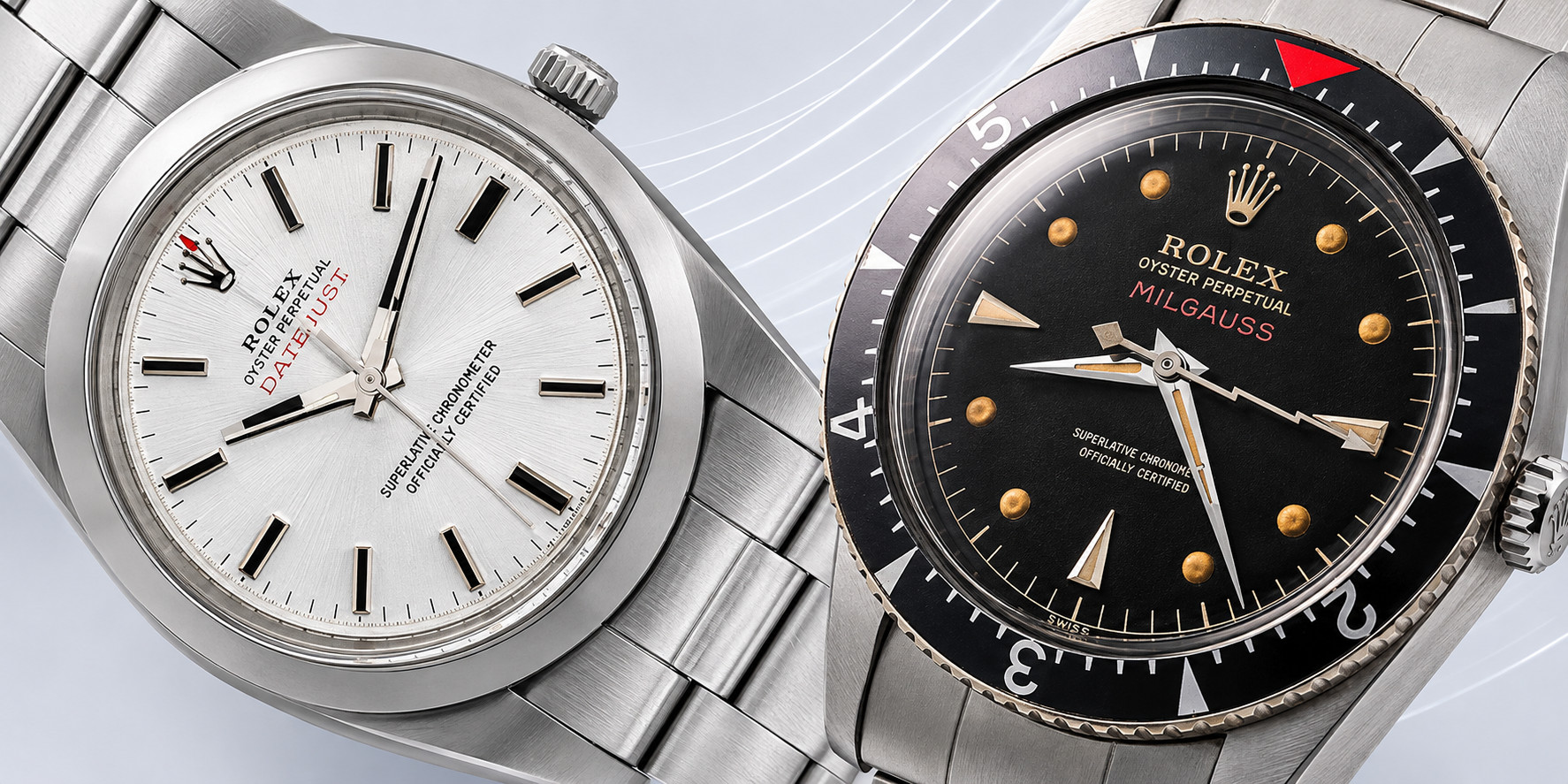
The Rolex Milgauss
Rolex is able to pull off something unusual in the watch world — in the world of luxury goods in general. On the one hand, it constantly trumpets the tool credentials of its watches. On the other hand, despite its prolific manufacturing capacity, it creates an aura of exclusivity and unattainability around them. Street cred and luxury; now that is marketing prowess.
Rather strange, then, that it hasn’t managed to do its magic with the utterly charming Milgauss. One would think that its elegant design and association with the scientists at the European Organisation for Nuclear Research (CERN) would do wonders for its sales figures, but the Milgauss never quite found its customer. In 2023, Rolex discontinued the model for the second time.
The Milgauss’s combination of utility and urbane sophistication is pure Rolex. We certainly hope that another resurrection is in the cards. This brief overview is our way of keeping the Milgauss flame burning.
Reference 6543
The Milgauss made its debut with this reference in 1954. Its primary selling point is its anti-magnetic resistance, rated at 1,000 gauss — hence its name: mille (1,000) + gauss (unit of magnetic flux density). It achieves this via the iron cage that shrouds the movement. The Faraday cage (so named after its inventor) is also responsible for much of the case’s thickness. The 60-minute-graduated bezel, the black dial and Oyster bracelet make it look similar to a Submariner. Its case is 38 mm wide. It has a straight seconds hand and its hour markers are circles, with polished darts at the 3, 6, 9 positions. MILGAUSS is prominently written in red on the dial’s upper half. The 1080 calibre has movement duties.
Reference 6541
Produced between 1956 and 1960, ref. 6541 is quite similar to the 6543. It is still moved by the 1080 calibre, and still features the Faraday cage and the black bezel (although some examples have a smooth bezel). The most visible difference is in the seconds hand, which now has the iconic lightning-bolt design.
Reference 1019
Released in 1960, the 1019 is almost unrecognisably different to its predecessors. Gone are the Submariner-style bezel, the lightning-bolt seconds hand and the honeycomb dial. Its bezel is smooth stainless steel and its matte dial comes in three versions: sliver, black and sliver without lume, per the request of CERN scientists, who found that the tritium mangled their experiments. The 1580 calibre has a hacking function and beats at a higher rate than its predecessor. Despite unimpressive sales, Rolex hung on to this reference for 28 years, making it one of the longest-lived in Rolex’s history.
Reference 116400
The Milgauss made a spectacular comeback in 2007. The reintroduced model still had the anti-magnetic cage, but the movement itself — the 3131 calibre — increased the anti-magnetic resistance with its Parachrom Bleu hairspring. The orange lightning-bolt seconds hand is evocative of ref. 6541. Its diameter is at 40 mm and its bezel is smooth. The dial originally came in three versions: white, black and the 116400GV black dial with the green sapphire crystal. This crystal is reportedly so difficult to make that it is imitation-proof — so much so that Rolex didn’t bother with a patent. In 2014 a blue dial was added to the GV lineup — the Z-Blue — and soon thereafter the non-GV models were retired. Unfortunately, the 116400GV’s bold dash of colour did not charm the customers and Rolex withdrew the Milgauss once again in 2023.