


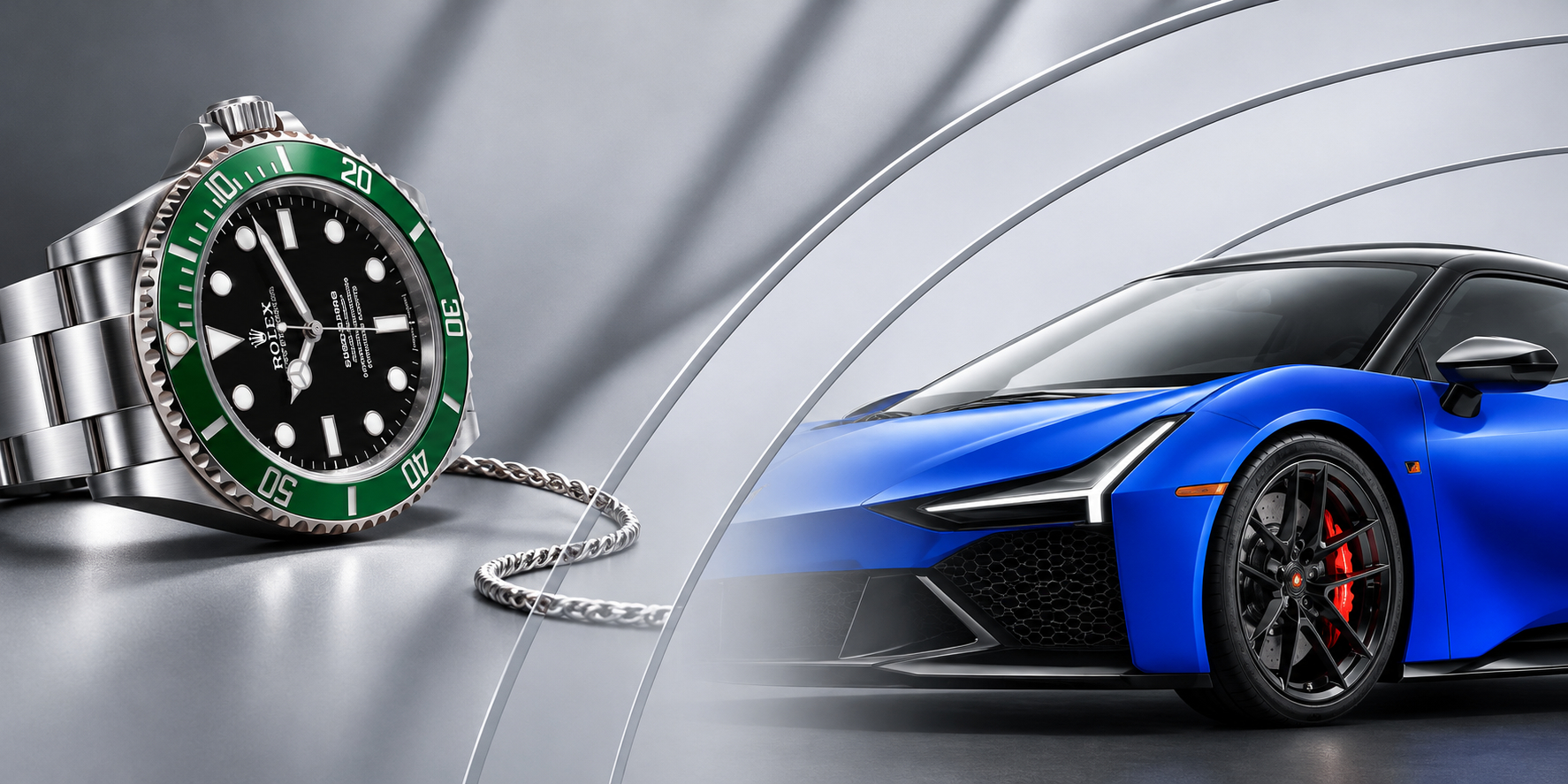
The question is not as fanciful as it might appear. Judging by the frequency of automotive and horological collaborations — Bentley and Breitling, for example — brands are very aware of the significant overlap between the car-enthusiast and the watch-enthusiast crowds. The relationship is well founded. Cars and watches are both marvellous pieces of engineering, composed of numerous parts working together in delicate harmony. At their best, they both blend function and form, science and aesthetics. Personal timekeeping and personal transport technologies have undergone co-evolution and both are defining features of our modern way of life. And, of course, both cars and watches signal status.
Most people, unfortunately, can’t just go buying stuff on a whim. Necessity makes prudent and discriminating consumers out of most of us. So, if you feel the time has come for that piggy bank to bust open, but are not quite sure whether your money would be better spent automotively or horologically, here are a few considerations.
First, a caveat. We respect readers of this blog too much to pretend that we are neutral on this question; we are called The Watchpoint, after all. Nevertheless, we’ll do our best to make as reasoned a case as possible.
Here we go.
Utility
Nowadays, digital technologies have displaced their analog counterparts almost entirely; the multifunctional smartphone is more than capable of handling timekeeping duties. But we still need cars to take us to work. If your job requires social interaction, showing up to work in a beater while sporting a Rolex would be ill-advised; people would rightly question your priorities.
On the other hand, if you work mostly from home, your car is less vital to you. If that beater still gets you from point A to point B, why not buy an elegant new timepiece instead? It may not keep time as accurately as quartz or digital devices but a chronometer-certified mechanical watch is still very accurate. Plus, it’ll get your heart racing every time you flick your wrist. Reduced screen time is yet another benefit.
Ownership Cost and Value Retention
For all its extraordinary benefits, digital technology comes with fragility and built-in obsolescence. Gone are the days when certain Mercedes models — such as the 240 D — were realistically expected to keep running beyond the million-mile mark. Contemporary vehicles are essentially rolling computers and although they are in many ways far more capable than their mostly-mechanical ancestors, the increased reliance on microchips has raised the maintenance stakes and reduced average lifespans. In fact, cars have always been and remain notorious value losers. A shiny new model starts depreciating the minute it rolls out of the showroom floor. Insurance premiums and vehicle-related taxes only add to the liability.
Mechanical watches, in contrast, are excellent value retainers. A watch that is properly looked after can be passed down to the next generation. The basis of the technology is a few centuries old, which means it has stood the test of time. On the maintenance front, even for a piece with several complications, five-year service intervals are not uncommon. And although it’s certainly advisable to take anti-theft measures — as with any expensive item — the cost of keeping a watch on the wrist pales in comparison to the cost of keeping a car on the road.
Soul
We concede that aesthetic judgements are a largely subjective matter, but we are not the only ones who think that the digitalisation of the automotive industry has gone hand in hand with aesthetic decline — no more of the lush curves and the visible signature of the craftsman that defined vehicle design for much of the twentieth century. Moreover, the introduction of intrusive (and often legally mandated) driving aids such as traction control have diminished the importance of driver input. The result is a rather soulless driving experience.
In the analog world of mechanical watches, however, beauty retains its eminence. One might say the watch world has managed to cheat time: it has taken full advantage of contemporary advances in materials science, while staying true to the aesthetic sensibilities of a simpler time. Few contemporary objects are able to blend function and form, the tactile and the visual so pleasingly. Decades from now, many 2024 models from high-end watch marques will still be coveted because their design is timeless. The same is simply not true of cars.